FAZIATHIN, L. Baldesi, S. Valdre, G. Casini
Testing new FAZIA telescopes featuring customized ultrathin DeltaE silicon stage for low-energy ion spectroscopy FAZIA in the GARFIELD scattering chamber, Hall 3
- 2 min read
(FAZIA Collaboration)
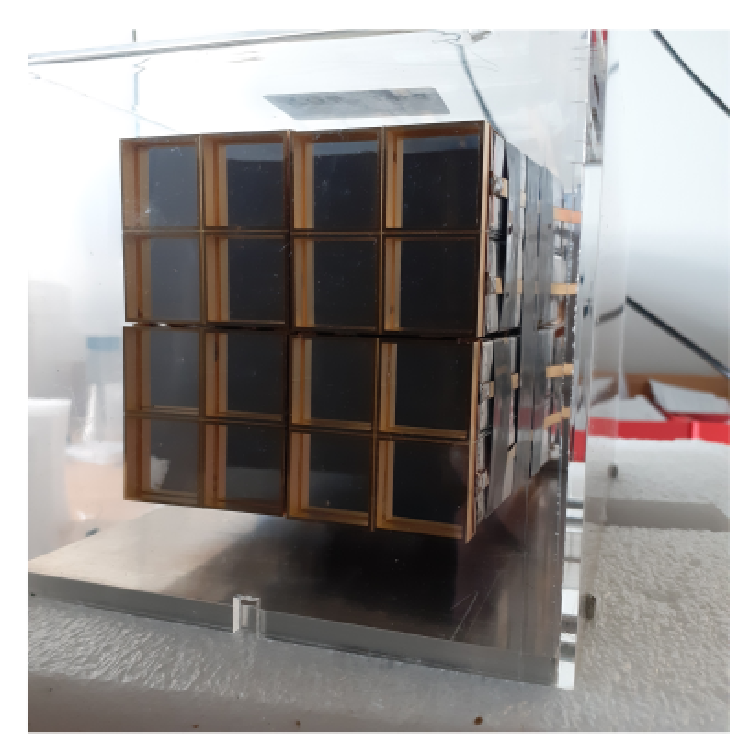
The international FAZIA collaboration is active in the study of heavy-ion reaction mechanisms with specific focus on the Equation of State (EoS) of nuclear matter and on the cluster properties in excited systems. For this goal the collaboration designed, developed and built an array of three stage telescopes (Si-Si-CsI), with excellent performance in terms of energy resolution and isotopic separation of the detected ions in a broad range of ion energy. The characteristics and the per- formances of FAZIA are reported in the literature. The main activity of the collaboration concentrates on the region of the Fermi energies where the dynamics of the collisions, thanks to the contribution of N-N collisions on top of the mean field interaction, is able to produce nuclear systems very far from the ground-state, thus better enlightening effects related to highly excited degrees of freedom. After the first experiments at INFN-LNS with a reduced version of the ap- paratus (4Pi blocks), since 2019 twelve blocks of FAZIA (each composed of 16 telescopes) are used at GANIL coupled with the INDRA detector. The FAZIA telescopes are mounted at forward angles (from 2° to 14°) in the big scattering chamber hosting the INDRA rings that cover with very large acceptance and good granularity the rest of the polar range. With this efficient detector, a series of experiments has been performed (and others are already planned for 2025) to precisely measure the characteristics of the quasi-projectile (QP), complex fragments and ligth particles thus allowing to investigate the isospin transport and fragment production in dissipative collisions.
- Tags:
- Fazia
- LNL
- Experiment
- Detector
- Faziathin