E884, C. Ciampi, J. Frankland
Impact of projectile-target size asymmetry on the isospin equilibration rate extracted from quasiprojectile breakup reactions
- 2 min read
L. Baldesi, S. Barlini, B. Borderie, R. Bougault, A. Camaiani, G. Casini, A. Chbihi, C. Ciampi, J. Duenas, Q. FABLE, J. Frankland, D. Gruyer, Hong Byungsik, Kim Sunji, A. Kordyasz, Kweon Min Jung, N. Le Neindre, I. Lombardo, O. Lopez, T. Marchi, K. Mazurek, M. Parlog, G. Pasquali, M. G. Pellegriti, S. Piantelli, G. Poggi, A. Rebillard-Soulié, S. Valdre,G. Verde, E. Vient
(INDRA-FAZIA Collaboration)
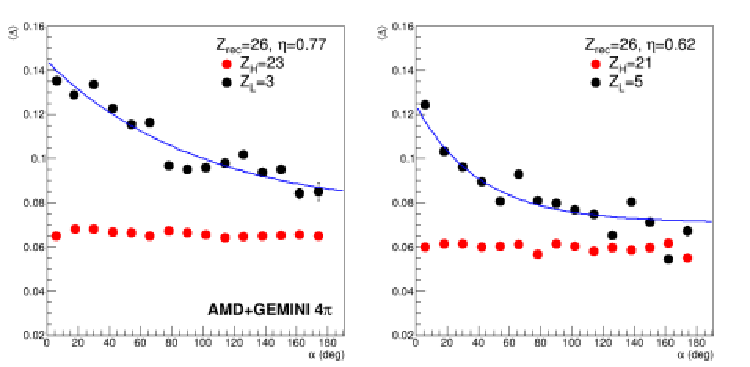
We propose an experiment to investigate the isospin transport mechanisms in quasiprojectile (QP) binary breakup events in semiperipheral heavy ion collisions at Fermi energies (35 MeV/nucl.), focusing on the isospin equilibration taking place inside the deformed QP* prior to its breakup. The isospin content of the two daughter nuclei will be correlated to breakup characteristics such as the angular alignment of the two fragments, in order to extract the information on the fission timescale and hence on the rate of the isospin equilibration. By employing the same 70 Zn projectile impinging on three targets, significantly different both in size and isospin composition, we aim to probe to what extent the evolution towards isospin equilibration inside the deformed QP* depends on the preceding step of the reaction, in view of clarifying contrasting results found in the literature. The identification performance of the INDRA-FAZIA apparatus will allow for the mass identification of both breakup fragments in most QP breakup events, and its large angular coverage will at the same time provide good global characterization of the reactions, which was not achieved in most previous studies.