E818, R. Bougault, G. Casini
EExtending our knowledge of Warm Dense Nuclear Matter in the low density region.
- 2 min read
S. Barlini, E. Bonnet, B. Borderie, R. Bougault, A. M. Buccola, A. Camaiani, G. Casini, A. Chbihi, C. Ciampi, M. Cicerchia, M. cinausero, J. Duenas, D. Fabris, J. Frankland, C. Frosin, F. Gramegna, D. Gruyer, F. Gulminelli, K. Hahn, M. Henri, Hong Byungsik, Kim Sunji, T. Kozik, Kweon Min Jung, N. Le Neindre, J. Lemarie, I. Lombardo, O. Lopez, G. Mantovani, T. Marchi, Nam Seonho, P. Ottanelli, H. Pais, M. Parlog, G. Pasquali, S. Piantelli, G. Poggi, C. Providencia, J. Quicray,A. Stefanini, Sun Baohua, A.-M. Sanchez-Benitez, S. Upadhyaya, S. Valdre,G. Verde, E. Vient
(INDRA-FAZIA Collaboration)
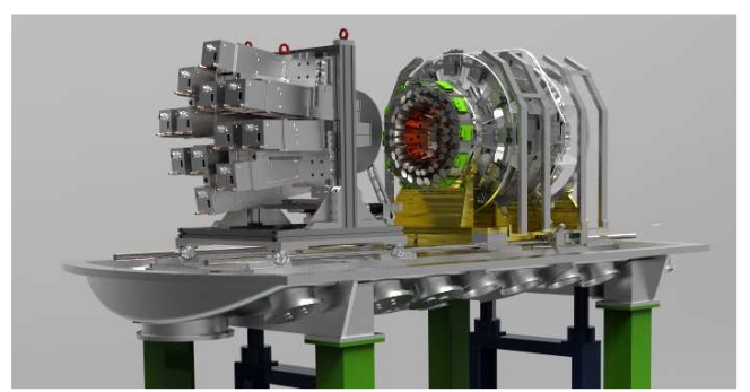
The equation of state with light clusters for nuclear and stellar matter was determined using 2 H, 3 H, 3 He, 4 He, 6 He chemical equilibrium constants evaluated from the analysis of the recently published INDRA heavy ion data. The measured multiplicities were used to extract the thermodynamic properties, and an in-medium correction to the ideal gas internal partition function of the clusters was included in the analysis. This in-medium correction and its respective uncertainty was calculated via a Bayesian analysis, with the unique hypothesis that the different nuclear species in a given sample must correspond to a unique common value for the density of the expanding source. A comparison with a relativistic mean field model has proven that data are consistent with a universal in- medium correction of the scalar sigma-meson coupling for nucleons bound in clusters. The obtained value is larger than the one obtained in a previous study using Texas A&M data but not including in-medium effects in the data analysis. This implies smaller effects on the binding energy of the clusters and, as a consequence, larger melting densities, and an increased cluster contribution in supernova matter. The goal of the proposed experiment is to confirm the in-medium measurement from an analysis of the intermediate energy heavy-ion collisions leading to vaporization and vaporization-like of the quasi-projectile (QP) and to extend the measure to heavier clusters. The data will be revealed by the FAZIA and INDRA multi-detectors. Two different reactions are considered in order to study two QP sizes.
- Tags:
- Indrafazia
- Ganil
- Experiment
- Clusters
- E818