PhD defence of Alex Rebillard-Soulié
Alex Rebillard-Soulié defended his PhD thesis on "Extending our knowledge of low density and hot nuclear matter" at LPC Caen
- 2 min read
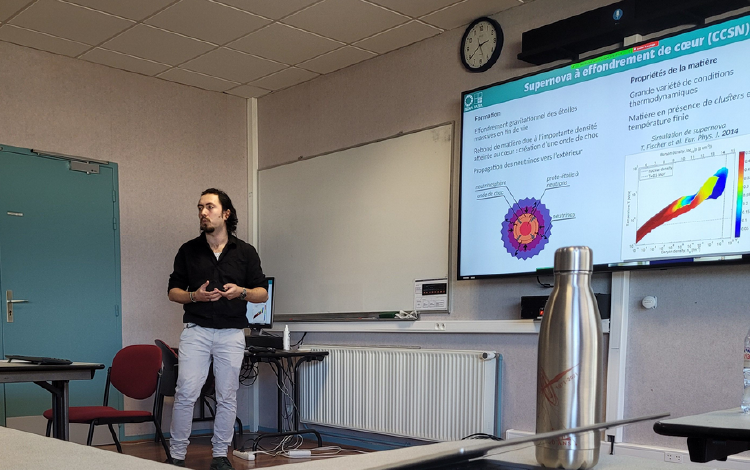
Light cluters and supernovae
Light clusters in nuclear matter appear at densities below nuclear saturation density. They can play an important role in astrophysical scenarios like core-collapse supernovae, where the properties of nuclear matter influence the shock wave propagation and the path of emitted neutrinos. At such densities, in-medium effects are present and modify the properties of the formed clusters, their abundance, and, consequently, the dynamics of supernovae.
Model calibration with experimental data
We used a relativistic mean field (RMF) model with clusters as explicit degrees of freedom and virtual meson exchanges. This model includes an empirical cluster-meson coupling that requires calibration with experimental observations.
From heavy ion collisions, we selected events to construct different statistical ensembles corresponding to particular thermodynamic conditions. In these ensembles, we extracted the chemical compositions in terms of the mass fractions of hydrogen and helium isotopes.
In parallel, we strengthened the use of the equilibrium hypothesis by studying isoscaling properties.
Finally, in a Bayesian analysis, we compared the experimental ensembles with calculations from the RMF model, where density, temperature, and cluster-meson coupling are free parameters. We successfully reproduced the experimental mass fractions of the various clusters, considering a unique density for each ensemble. The cluster-meson coupling has been calibrated for different temperatures.


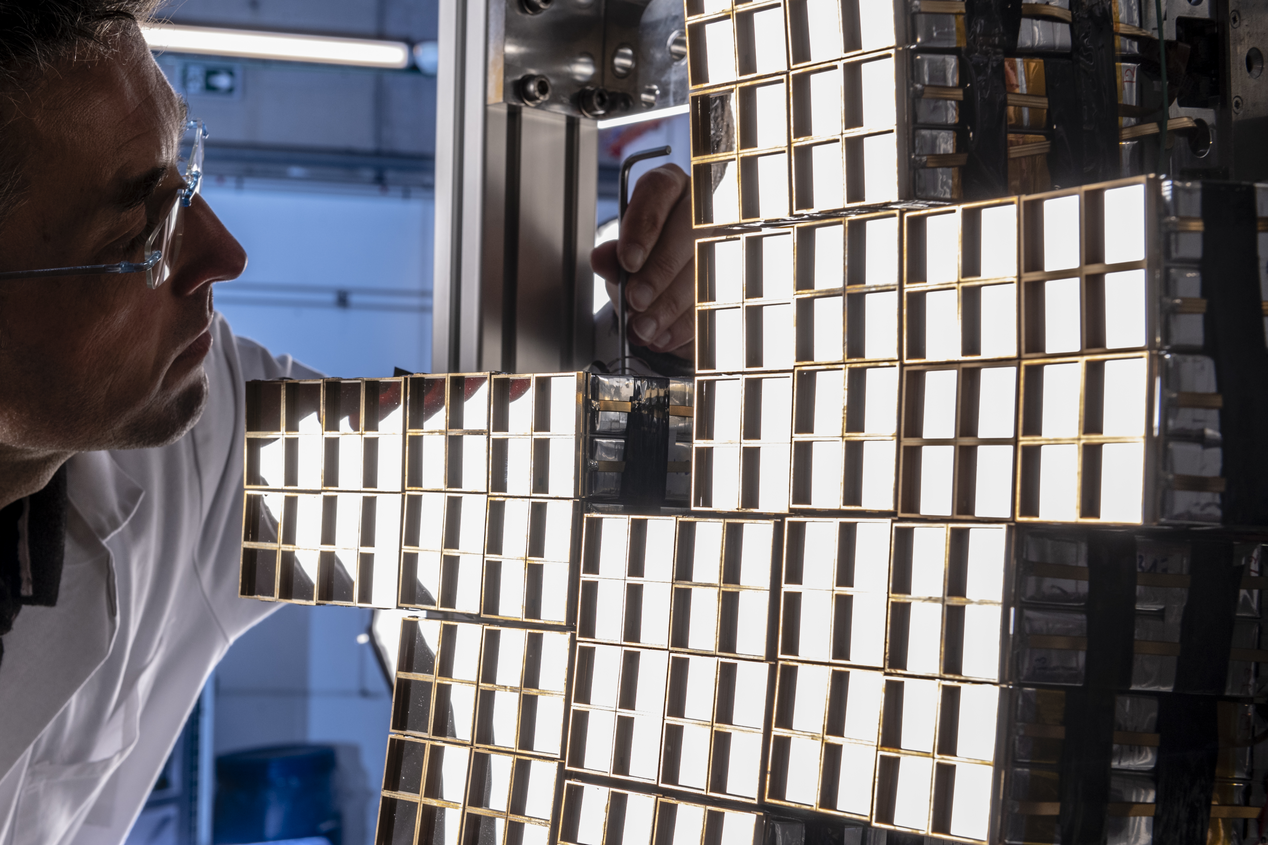
New INDRA-FAZIA data
To explore the limitations of this analysis and extend it to other systems, a new experiment was conducted with the INDRA-FAZIA multidetector. Significant improvements were made to the device, which has considerably enhanced its performance, particularly in terms of isotopic identification. Consequently, nearly all of the data reduction work (energy calibration and identification) has been completed for this new experiment. In a preliminary study, the analysis began on vaporization-type events, but further investigations are required.
- Tags:
- Phd
- Clusters
- Astrophysics